
Replacement of the eye lens
Revitalize your vision with lens replacement surgery in Bosnia and Herzegovina
Everything you need to know about replacement of the eye lens
Lens replacement suitability criteria
Presbyopia, or simpler, near vision disturbance, is a common problem for patients after the age of 45, and sometimes even earlier.
This issue can be solved today with the implantation of multifocal intraocular lenses, or even with the extended depth of focus (EDOF).
Almost all patients older than 45 years who want to get rid of their reading glasses are good candidates for this surgery. There is no upper age limit, but it is important that the macula (back of the eye) is healthy and preserved to get the full effect of these lenses.
How lens replacement exchange works
Before the surgery, a detailed examination of the anterior and posterior segments of the eye is performed, and a calculation of the intraocular lens power is made. The patient is presented with the results and based on a detailed conversation with the surgeon, the best option is chosen. We emphasize that preoperative patient/surgeon consultation is of the utmost importance. A patient’s everyday activities, habits and expectations are thoroughly discussed, so there is no misunderstanding about potential postoperative limitations.
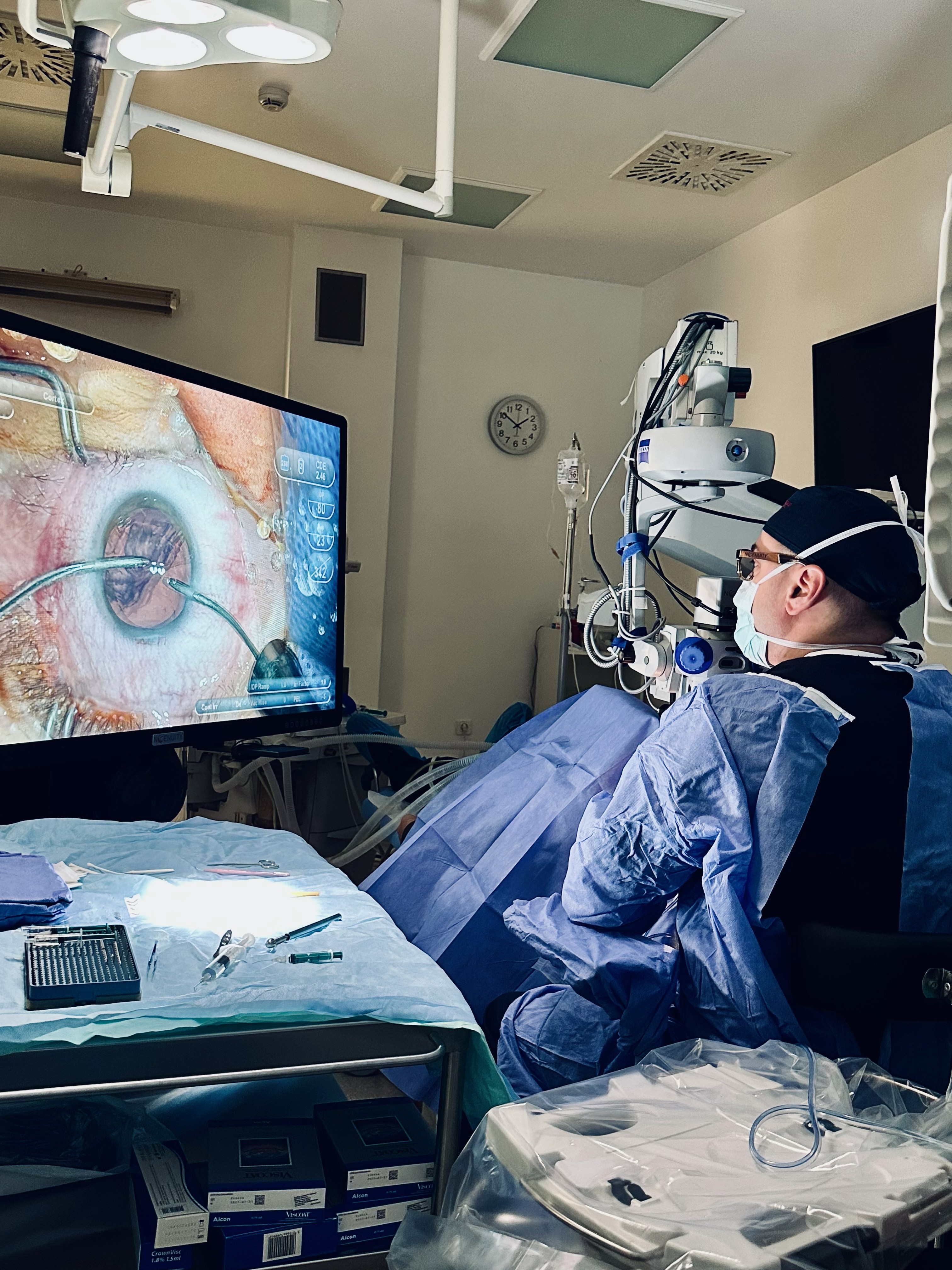
The surgical procedure lasts only 10 minutes per eye. Sometimes we do one eye first and the other one in the next few days, but oftentimes both eyes are operated on the same day. In almost all patients the topical anaesthesia (anaesthesia with the eyedrops) is sufficient. During the procedure, the natural eye lens is removed, and an EDOF/trifocal lens is implanted in its place.
The incisions heal by themselves, so there is no need to suture the wound.
Advantages and disadvantages of lens replacement
Advantages of Lens Replacement Surgery:
Lens replacement surgery can significantly reduce the need for glasses, offering clearer vision at all distances. It’s a permanent solution for age-related vision problems like presbyopia and cataracts, improving your quality of life. Recovery is usually quick, and the new lens lasts a lifetime.
Disadvantages:
Adjusting to the new vision may take time, and there’s a small risk of complications like glare or halos. The procedure may also be more expensive than traditional cataract surgery.
Lens replacement risks
Lens replacement surgery, while generally safe, carries some risks. These include potential infections, increased eye pressure, or retinal detachment. Some patients may experience glare, halos, or difficulty adjusting to their new vision. Rarely, there may be complications that require additional surgery. However, these risks are minimal when performed by an experienced surgeon, and the vast majority of patients experience successful outcomes with improved vision.
Types of intraocular lenses
When it comes to presbyopia, there are two types of intraocular lenses that can solve this refractive error.
The first ones are diffractive trifocal intraocular lenses. The optic of these lenses is designed with more than one focal zone, which means that depending on the pupil size the person can see far, intermediate, and near without glasses, and all depending on the focal zone they are looking through.
On the other hand, the EDOF lenses are the latest technological achievement when it comes to correcting vision over all distances. This technology is more reliant on the natural pupil size and has only two indistinct focal zones. With these lenses, patients can have excellent far and intermediate vision, and very good near vision.
Some patients must wear reading glasses even after the implantation of these lenses, but usually only for the smallest print. However, their advantage is lack of photic phenomena, also known as halos and glare.
This phenomenon is seen in all diffractive trifocal intraocular lenses and consists of starbursts that patients see during the night and slight decrease in contrast sensitivity.
The second group consists of the so-called diffractive multifocal intraocular lenses, known for more than 15 years.
Although today’s technology is much more advanced than previous generations, they still have similar or the same side effects. They are reflected in a greater or lesser degree of scattering of light at night and a slight decrease in color contrast.
Nevertheless, with these implants, patients see excellently at distance and medium distance, as well as with EDOF lenses, and the independence from near glasses is over 95%
Lens replacement steps
Lens replacement surgery involves several steps.
- First, numbing drops are applied to the eye
- A small incision is then made in the cornea, through which the cloudy natural lens is removed
- An artificial intraocular lens (IOL) is inserted into the same position
- The procedure is quick, usually under 30 minutes, and no stitches are required.
After the surgery, patients may be prescribed eye drops to prevent infection and reduce swelling during recovery.
Lens replacement results
The recovery lasts several days, usually five to six. During this time, the patient is advised to avoid smoke, wind, and dust, as well as lifting heavy weights. Antibiotic/corticosteroid eyedrops are also used during this time.
These lenses are permanent, they do not need to be exchanged, nor can they become cloudy like our natural eye lenses, which means that cataract cannot develop on them.
Gallery
Learn how other people overcame their dependence, and find out how you can, too
Join thousands who have achieved freedom from glasses and contacts
LASIK
Sehr freundliches und kompetentes Team! Dr. Kozomara, selbst ist fachlich top! Fühlte mich sehr gut aufgehoben. Wurde umfassend aufgeklärt. Seit ein paar Tagen sehe ich in HD Qualität :-))) (Lasik) Herzlichen Dank!!!

I.A.
Sehr freundliches Personal, medezienische Fach und Technik höchste Qualität

L.B.
Academic resources on lens replacement
Expand your knowledge about lens replacement. (These links will take you away from our website)
Refractive lens replacement (RLE) is a surgical procedure that replaces the eye's natural lens with an artificial intraocular lens (IOL) to correct refractive errors such as myopia, hypermetropia, and presbyopia. This procedure is particularly useful for patients with cataracts or those seeking an alternative to laser vision correction. RLE offers immediate vision improvements and can reduce dependence on glasses or contact lenses. However, like any operation, it carries risks, which makes a thorough consultation essential.
Refractive intraocular lenses (IOLs) are advanced options for patients undergoing refractive lens exchange (RLE). These lenses correct common vision problems such as myopia, hyperopia and presbyopia, improving visual outcomes. The guide explores the different types of refractive IOLs, their benefits, and how they compare to traditional lenses. By providing insights into the selection process, potential risks, and expectations during recovery, this resource helps patients make informed decisions about vision correction options.