
Cataract surgery
Restore clear vision and defeat cataracts in Bosnia and Herzegovina
Everything you need to know about cataract surgery
Cataract surgery suitability criteria
Some refer to this condition as “clouding of the eye’s natural lens”, and others as cataracts, but what is certain is that it represents partial or complete clouding of the naturally transparent lens of the eye, which enables us to create a clear image of objects we see at all distances.
Cataracts are considered one of the most common eye conditions in individuals over 70 years of age. However, lens clouding can occur at any age and may even be congenital.
A comprehensive eye examination, including pupil dilation and examination of the eye’s fundus, can indicate the presence of cataracts in one or both eyes.
And this diagnosis is not a reason for discouragement because there is a solution.
How cataract surgery works
Despite the once heavy and risky procedures to address this eye problem, technological advances have enabled cataract surgery to be successfully performed today, with excellent vision restored to the patient the day after surgery.
And cataract surgery is precisely the most commonly performed eye surgery worldwide.
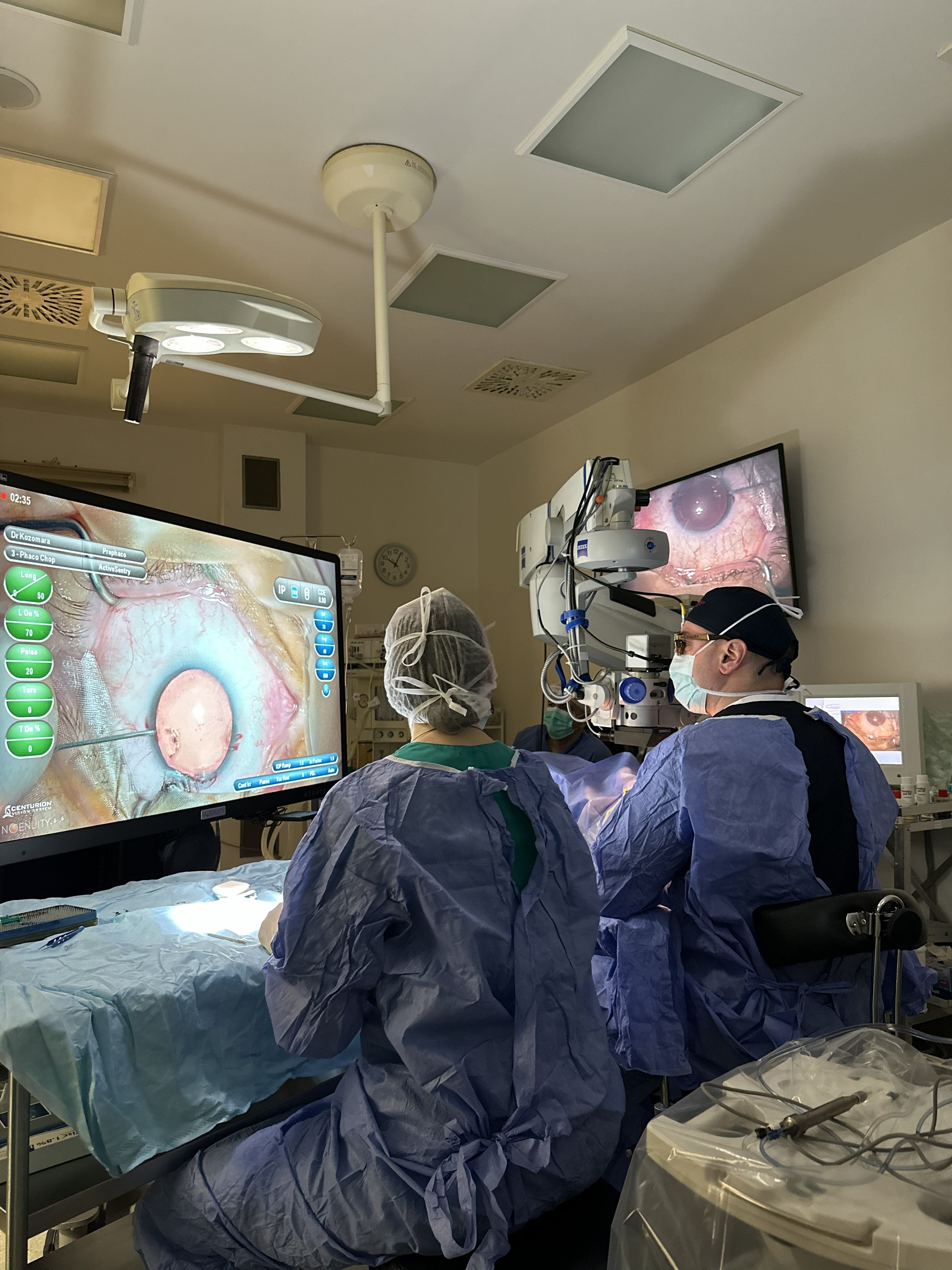
The entire procedure is performed under topical anesthesia (anesthesia with eye drops), where the cloudy natural lens is removed through a small opening in the eye’s cornea and replaced with an artificial one, allowing vision to return to the operated eye. The corneal incision heals on its own, and no sutures are needed.
The patient leaves the hospital immediately after the operation, and the postoperative course lasts up to 5 days. Antibiotic eye drops are used as therapy, and it is advised to avoid smoke, wind, dust, and heavy lifting.
Depending on the type of lens to be implanted, the patient can expect to see either at a distance without glasses or both at a distance and close up without glasses.
Advantages and disadvantages of cataract surgery
Advantages:
- A major benefit: Over 90% of people experience excellent distance vision (20/25 or better) without the need for glasses
- Premium cataract surgery has a high satisfaction rate, with very few complications
- The procedure is quick, usually taking less than 10 minutes, and you can return home the same day
- Many patients notice improved vision as soon as the next day.
- Recovery is generally fast and straightforward
- The new lens is permanent, so no need for future replacements.
Disadvantages:
- Compared to traditional cataract surgery, it might take a little more time to adjust to your new vision with lifestyle cataract surgery. Your sight may take a bit longer to stabilise.
- It’s all about what suits your lifestyle and vision goals, and we're here to help you make the best decision.
Cataract surgery risks
Let’s go over the risks of cataract surgery, and zoom in on those tied to using multifocal or toric lenses.
Cataract Surgery Risks:
- Infection: Like with any surgery, there's a small chance of infection, but we take all the sterile steps to keep that risk low
- Bleeding: A bit of bleeding is normal, but anything more should be checked out
- Swelling: Your eye might puff up a bit, but this usually goes down soon
- Pressure Changes: The pressure in your eye might hop up or down; we'll keep an eye on this
- Vision Trouble: Rarely, folks might experience blurriness, glares, or even a dip in vision. It's crucial to let us know if something feels off.
Now, when it comes to Premium Cataract Surgery:
- Adjustment Time: Multifocal lenses might need a little getting used to. Your brain has to learn to pick the right focus for the right distance
- Night Vision Glare: Some people notice rings or glare around lights at night
- Imperfect Focus: Multifocal lenses aim to cover all distances, but sometimes they might not hit the mark perfectly, needing glasses now and then
- Lens Position: Toric lenses, which correct astigmatism (a kind of blurry vision), need to sit just right in the eye. If they shift, your vision won't be as clear and might need a touch-up.
While these risks sound a bit daunting, remember, cataract surgery is one of the most common and successful surgeries out there. And these lenses can really up the game in how you see the world post-surgery. We’ll be with you every step of the way, making sure you're informed and comfortable with your choices.
Cataract surgery options and alternatives
There is no other treatment or remedy for cataracts other than surgery. Most importantly, cataracts cannot lead to permanent vision loss; vision is restored after the cloudy natural lens is removed (provided there are no other eye conditions).
Cataract surgery steps
Step One: We'll start by applying numbing drops to your eye and giving you something mild to help you relax. After that, we make a tiny incision on the clear part of your eye, known as the cornea
Step Two: Through this small incision, we insert a fine tool that uses gentle sound waves to break up the cloudy lens into tiny fragments. We carefully remove the pieces, using a special microscope to ensure everything is cleared out
Step Three: Next, we insert a new lens, rolling it up and sliding it into the same position where your old lens was. The small incision closes on its own, so no stitches are required
Step Four: We place a clear shield over your eye to protect it for the first few hours after surgery. You'll also need to start using eye drops to prevent infection and reduce swelling. The surgery itself is quick, typically taking less than an hour, but you'll spend about three hours in total at the hospital.
These steps are designed to ensure your comfort and make the journey to clearer vision as smooth as possible.
Cataract surgery results
Cataract surgery is like pulling back the curtains to reveal a brighter, clearer world. Here’s a glimpse at the benefits it brings:
- Sharper Vision: The biggest perk is regaining crisp, high-definition vision. That frustrating blurriness fades away, letting you see the world in vivid, vibrant colours, like upgrading from an old, fuzzy TV to a brand-new one
- Easier Everyday Life: Once the haze is gone, daily tasks like driving, reading, or enjoying hobbies such as sewing or golfing become effortless. It's as if the world is open to you again
- Freedom from Glasses: One of the best parts? You may no longer need glasses or contact lenses for most activities. If you opt for a multifocal lens, it helps you see clearly at all distances—near, far, and in between—cutting down on the need for multiple pairs of glasses
- Brighter, More Active Days: Clear vision is just the beginning; it can lead to a more energetic and social lifestyle. When you can see the world in full colour, life feels more inviting
- Safer Movements: Better vision means moving around with more confidence and reducing the risk of trips or bumps. It’s like having a clearer map to guide you through the day
- Quick and Long-Lasting Results: Improved vision often comes within a day or two, and the new lens is built to last for years, even decades
- Boost in Confidence: Seeing clearly gives a boost to your confidence, making daily tasks easier and helping you savour life’s special moments without worrying about poor vision.
Choosing cataract surgery means choosing to see life in a sharper, clearer way. Many have taken this step and found a vibrant new perspective. It’s not just about clearing up your vision; it’s about embracing a more independent, fulfilling life with less time spent dealing with glasses or contacts.
Gallery
Learn how other people overcame their dependence, and find out how you can, too
Join thousands who have achieved freedom from glasses and contacts
LASIK
Sehr freundliches und kompetentes Team! Dr. Kozomara, selbst ist fachlich top! Fühlte mich sehr gut aufgehoben. Wurde umfassend aufgeklärt. Seit ein paar Tagen sehe ich in HD Qualität :-))) (Lasik) Herzlichen Dank!!!

I.A.
Sehr freundliches Personal, medezienische Fach und Technik höchste Qualität

L.B.
Academic resources on cataracts
Expand your knowledge about cataracts. (These links will take you away from our website)
Cataract surgery is a common procedure that aims to remove the clouded lens to restore clear vision. It is usually performed as an outpatient surgery, under local anesthesia, and can be completed in less than an hour. The most common technique, phacoemulsification, uses ultrasound to break up the cataract, allowing the surgeon to remove it and replace it with an artificial lens. Understanding the process, recovery, and potential risks is critical for patients considering this life-changing surgery.
Refractive errors after cataract surgery can occur when the new intraocular lens (IOL) does not completely correct vision. Common problems include myopia, hypermetropia, and astigmatism, which can arise from preexisting conditions or errors in IOL power calculations. These postoperative refractive errors can often be resolved with corrective lenses or additional surgical interventions. Understanding the potential for these errors is critical for patients undergoing cataract surgery.