
Personalized treatment of the retina
Customized retinal treatments in Bosnia and Herzegovina
Everything you need to know about personalized treatment of the retina
Retinal treatment diagnosis
Diseases of the posterior segment of the eye, the retina, are often the most difficult to treat in modern ophthalmology. To determine the state of the eye’s retina, we use several methods:
- Ultrasound diagnostics
- OCT – optical coherence tomography
- Fundus photography
- Electroretinographic analysis
Diseases of the posterior eye segment
This is also the most common and complex eye damage in diabetic patients. Due to changes in metabolism, there is a disturbance in circulation in the capillary network of the retina, leading to damage to arteries and veins and leakage of blood onto the surface of the retina as well as into the vitreous body. Patients describe these damages as a decrease in visual acuity and poorer image quality, as well as the appearance of “dark spots or floaters” in the visual field. If you are diabetic, we recommend that you undergo an ophthalmological examination at least once a year, regardless of whether you recognize any of the symptoms mentioned above.
Age-related macular degeneration
Age brings many new, beautiful experiences, but also takes something from the overall health picture of a person. We know that one of the organs that can feel the effects of aging is precisely the eye, more specifically the macula, which is one of the most important anatomical parts of each eye.
How does this disease manifest?
Visual acuity decreases, and the damage is particularly pronounced in the “central” vision. The patient feels a large “spot” in front of one or both eyes, causing objects to appear blurry, but still maintains preserved peripheral vision.
Types of age-related macular degeneration
In practice, two forms of this condition are present: dry and wet. In the dry form of age-related macular degeneration, damage to central vision occurs gradually, over several years, even decades. Due to pronounced atherosclerosis of the retinal blood vessels, there is accumulation of cellular metabolic waste, hindering the normal functioning of remaining living cells. The accumulated material is called drusen.
The wet form is much more aggressive, occurring suddenly, marked by the appearance of a distinctly dark “spot” in front of the eye. Sudden vision loss is caused by the rupture of atherosclerotic retinal blood vessels and bleeding into the area of the macula. Even with this form of macular degeneration, peripheral vision may remain preserved.
How is it treated?
The dry form of age-related macular degeneration still cannot be treated, but the patient will never completely lose vision. Specifically, they will always retain what is known as peripheral vision, or vision outside the macula.
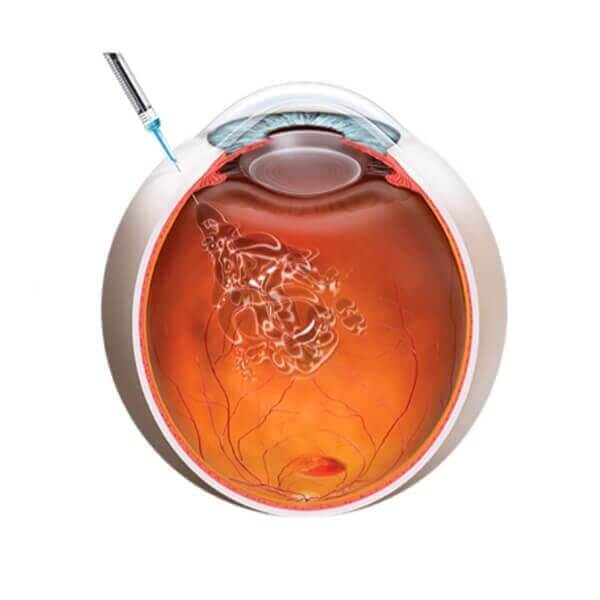
The wet form of senile macular degeneration is successfully treated if detected early with the application of anti-VEGF therapy (Avastin, Lucentis, Eylea). However, if detected late or inadequately treated, therapy may not be very effective due to the rapid formation of scarring in the macula, which remains untreatable.
Thrombosis of the vein and arterial embolism
This condition is also known as an eye infarction and often occurs as a result of uncontrolled or poorly controlled blood pressure, as well as high levels of fat in the blood.
Just as in a heart or brain infarction, a blockage of an eye artery or vein by a clot can occur, consequently leading to damage to a part of the visual field or complete visual acuity.
How is it treated?
Vein thrombosis and arterial embolism can be treated with the application of anti-VEGF therapy (Avastin, Lucentis, Eylea) or laser photocoagulation of the damaged areas on the retina.
In addition to ophthalmological treatment, it is necessary to perform detailed internal medicine and neurological examinations to prevent more severe damage to the heart or brain.
Gallery
Learn how other people overcame their dependence, and find out how you can, too
Join thousands who have achieved freedom from glasses and contacts
LASIK
Sehr freundliches und kompetentes Team! Dr. Kozomara, selbst ist fachlich top! Fühlte mich sehr gut aufgehoben. Wurde umfassend aufgeklärt. Seit ein paar Tagen sehe ich in HD Qualität :-))) (Lasik) Herzlichen Dank!!!

I.A.
Sehr freundliches Personal, medezienische Fach und Technik höchste Qualität

L.B.
Academic resources on retinal diseases
Expand your knowledge about retinal diseases. (These links will take you away from our website.)
Retinal diseases include a variety of conditions that affect the retina, the light-sensitive tissue at the back of the eye that is essential for vision. These conditions can cause symptoms such as blurred vision, floaters, and vision loss, depending on the underlying problem. Common retinal diseases include macular degeneration, diabetic retinopathy, retinal detachment, and retinitis pigmentosa. Retinal diseases can be caused by genetic factors, aging, diabetes, or trauma. Lifestyle factors such as smoking or hypertension also increase the risk. This article covers everything from diagnosis, treatment, prognosis, and more. Click here for more information.
Retinal diseases refer to conditions that affect the retina, the light-sensitive tissue at the back of the eye that is essential for vision. These conditions can cause symptoms such as blurred vision, floaters, and vision loss. Common diseases include macular degeneration, diabetic retinopathy, and retinitis pigmentosa, which can be caused by genetic factors, aging, diabetes, or eye injuries. Factors such as smoking can increase the risk. Early diagnosis and treatment, including medications and laser surgery, are key to managing these conditions. Click here for more information.